Apprenticeship
December 2005 - February 2006
I walked into the corral on a Saturday afternoon with a fourteen-foot lead rope, a stick with a string attached, a halter, and a notebook where I'd written down the exercises in order.
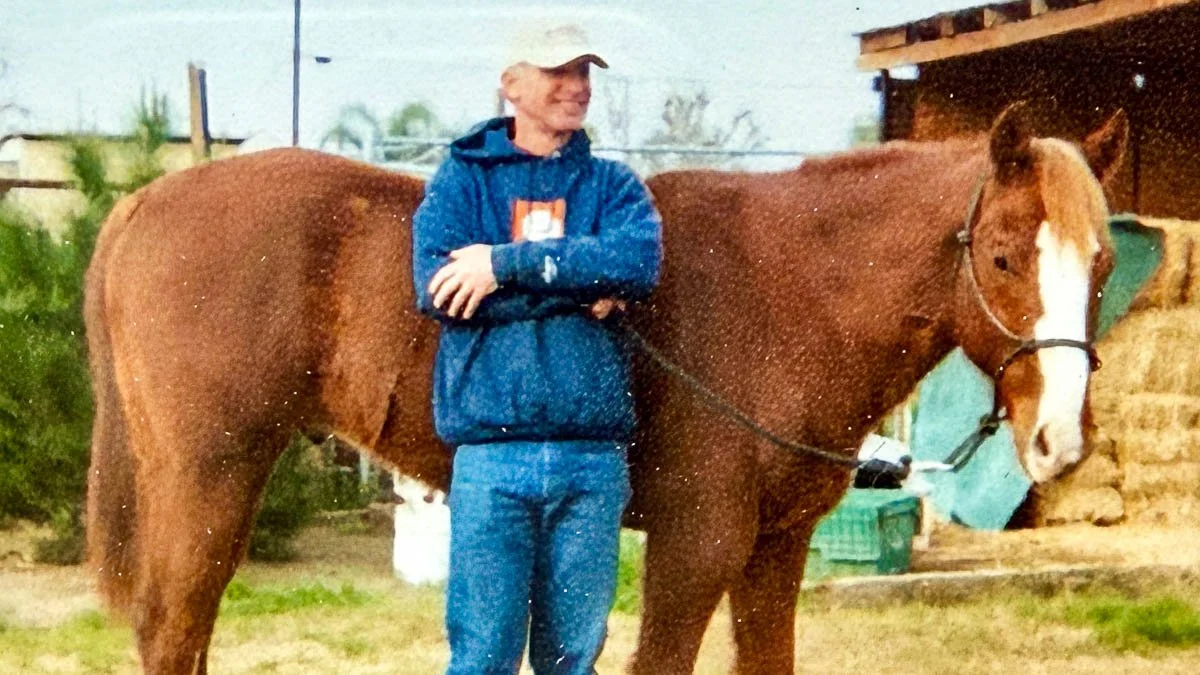
Tex stood in the corner, watching.
I'd studied the DVDs enough times to have the sequence memorized: desensitize with rope, desensitize with stick and string, lunge both directions, yield the hindquarters, flex at the neck, pick up feet, groom.
Simple. Clear. Logical.
What the DVDs didn't show was what to do when your lead rope slid under your boot while you were trying to step toward the horse. Or how to manage the stick in your left hand while keeping the rope organized in your right. Or where to look when the horse moved his feet in three directions while you were still thinking about the first one.
I dropped the stick once.
Lost the sequence twice.
Tex shifted left when I stepped right, and I had to untangle myself from my own equipment before we could try again.
Breathe. Slow down. Do one thing.
That became my mantra within the first twenty minutes.
But here's what surprised me: Tex tried anyway.
He didn't know what I was asking half the time. My timing was off. My cues were muddy. But when I got something even close to right, he'd give me a little—a step, a soften, a pause that said maybe this?
By the end of that first session, I'd managed to move him in a circle, get him to yield his hindquarters one stiff step, and pick up three of his four feet.
Nothing pretty.
Everything earned.
I wrote in the notebook: Tex did very good. Little resistance. Yielded hindquarters one step. Started lateral flexion.
Just facts.
But underneath those facts was relief.
We'd made a start.
The Weeks That Followed
We worked five, sometimes six days a week. Early mornings before work. Afternoons when I could get away. A few sessions at night under the corral lights, which weren't great but good enough.
The exercises started to flow better. Tex learned the patterns. I learned how to hold the rope without strangling myself with it. We found a rhythm that wasn't smooth yet, but at least wasn't chaos.
His lateral flexion softened. His backup improved from "confused" to "grudging" to "pretty good."
Other days felt like I'd learned nothing.
He'd move his feet during an exercise that had worked perfectly the day before.
I kept going back to the videos at night, rewinding the same sections, looking for what I was missing.
The Trailer
On the seventh day, I decided to work on trailer loading.
Bad idea.
I'd watched the DVD. I understood the concept. You make the wrong thing difficult and the right thing easy. You send the horse away from the trailer until he wants to rest, then you let him rest near the trailer. Eventually, the trailer becomes the comfortable place.
Simple.
Except Tex didn't read the script.
I worked him for two hours and fifteen minutes. Sent him in circles. Let him rest near the ramp. Sent him away again. Let him approach. He'd get his front feet in, then back out. Get halfway in, then scramble backward like the trailer might eat him.
By the end, I'd made it worse. He wouldn't even look at the trailer without tension running through his whole body.
I gave up and just let him stand there, nose to the trailer, while I tried not to feel like a complete fraud.
That night I rewatched the trailer loading section three times, looking for where I'd gone wrong.
The next morning, I tried again. This time I brought help—someone to stand behind him, not close, just present. That little bit of pressure from behind was enough. Tex walked in like he'd been doing it his whole life.
Not because I'd figured it out.
Because I'd learned to ask for help when stubbornness wasn't working.
A week later, I could load him by myself. Easily. No drama.
The breakthrough didn't feel like I'd thought it would. It felt like survival—like I'd barely hung on long enough for the horse to forgive my incompetence and meet me halfway.
I wrote: Trailer loading: loaded easily.
Two words to cover the two hardest weeks I'd had with him yet.
Getting On
By late January, the groundwork had settled enough that I started thinking about riding.
Tex had been saddled and ridden before I bought him, but not well, and not recently. I wanted to start fresh. Do it right. Build from the foundation I'd been working on instead of just climbing on and hoping.
I worked him from the ground with the saddle on, making sure he'd flex, yield, and stop before I ever put weight in the stirrup.
The first time I swung my leg over and sat in the saddle, Tex stood perfectly still.
Too still.
The kind of still that feels like a held breath.
I sat there, reins soft, just letting him feel my weight. I asked him to flex his head left, then right. Soft give on both sides. I asked him to take one step forward.
He did.
Then he stopped and waited.
I exhaled.
"Good boy."
We stood there another minute. Then I got off, loosened the cinch, and called it a day.
It wasn't dramatic. It wasn't the stuff of training montages. But it was the first time I'd been on his back without him questioning whether I belonged there.
Over the next two weeks, we did more. Walk. Trot. Working on one-rein stops and impulsion. His trot rattled my teeth, but his lope was smooth as anything I'd ever felt.
Some sessions went well. Others didn't.
On February 8, I spent ninety minutes trying to give him his booster vaccines. He wouldn't stand. Kept moving his feet, throwing his head, generally telling me he wanted no part of whatever I was trying to do.
I finally got the job done, but barely.
That night I wrote: He is still very excited, not much success with the vacs.
I was supposed to be getting better at this. I'd worked as a vet tech for years. Giving vaccines should've been routine. But Tex didn't know my résumé, and my hands remembered the doubt more than the skill.
Thirty Sessions
By early February, I'd worked Tex through thirty sessions.
Thirty mornings of waking up early. Thirty afternoons of leaving work to get saddle time in. Thirty evenings of reviewing what went wrong and what went right.
The mechanics were improving. I could move through the exercises without thinking about every step. Tex responded faster, softer, with less resistance than he had that first day when I'd tangled myself in my own lead rope.
I'd stopped hitting myself with the stick and string.
I could flex him from the saddle and get a soft give instead of a fight.
His backup was solid. His yielding was clean.
We'd built something.
I didn't know yet how incomplete it was.
Standing in the corral one cold morning after a good session, I looked at Tex and thought: We're ready.
Ready for longer rides. Ready for the trail. Ready to test this partnership somewhere beyond the safe rectangle of dirt where we'd spent the last three months.
The canal ran at the end of our block. Miles of riding in every direction. Open country where the real world could test what the corral had taught us.
I saddled Tex the next day and pointed him toward it.
I thought the training had prepared us.
What I didn't know yet was the difference between repetition and understanding.
The trail would teach me that.