Becoming a Student Again
Riding Because Someone Had To
When Ranae twisted her back, I started riding Dusty because somebody had to.
She worried that if he sat too long, his training would dull. He was young, newly settled, and too nice a horse to leave standing. She figured she’d be sidelined for at least a few weeks.
I told myself I was filling in.
Nothing more.
This wasn’t a decision about identity. It was logistics. A favor. Temporary.
At least that’s how I framed it.
Dusty made it easy to believe that story.
He stopped when asked. Went when suggested. Carried himself like a horse who already knew his job. He didn’t argue with my hands or question my timing. He absorbed my mistakes quietly and kept going.
That should have been reassuring.
Instead, it was unsettling.
Nothing I did seemed to matter very much.
Borrowed Ease
I wasn’t learning anything yet. I was getting away with things.
Dusty covered for me in ways I didn’t know how to measure. He filled in gaps I didn’t yet see. The rides ended without drama, which felt like success until I started wondering what, exactly, had gone right.
I didn’t trust the ease, but I couldn’t explain why.
Dusty wasn’t going to teach me anything I didn’t already think I knew.
Accidental Education
The curiosity wasn’t casual.
I’d spent my life around animals. Dogs, cats, chickens, goldfish. I’d worked in veterinary hospitals when I was younger. I’d trained a Frisbee dog to championship level. I understood behavior, conditioning, repetition, and reward.
Horses were different.
They were the first animals I couldn’t outwork, out-patience, or out-experience. For years, I’d assumed that gap was permanent—that horses were something you either grew up with or never truly understood.
RFD-TV challenged that assumption.
The DVR filled up quickly. Clinton Anderson. Chris Cox. John Lyons. Craig Cameron. I watched episodes twice. Sometimes three times. I took notes like I was studying for something I hadn’t admitted to yet.
The ideas weren’t mystical. They were mechanical. Pressure and release. Timing. Feel. Horses respond to clarity instead of force.
That was the unsettling part.
If this was a language, maybe it could be learned.
Dusty didn’t need much clarity from me.
That was the problem.
The concepts made sense on the screen, but I had no way to know if I could apply them. Dusty was finished enough that the work never got tested. I could ride him poorly and still feel competent.
That illusion wouldn’t last.
Enter Charlie
Ranae recovered, and Dusty went back to being her horse.
The riding stopped.
The thinking didn’t.
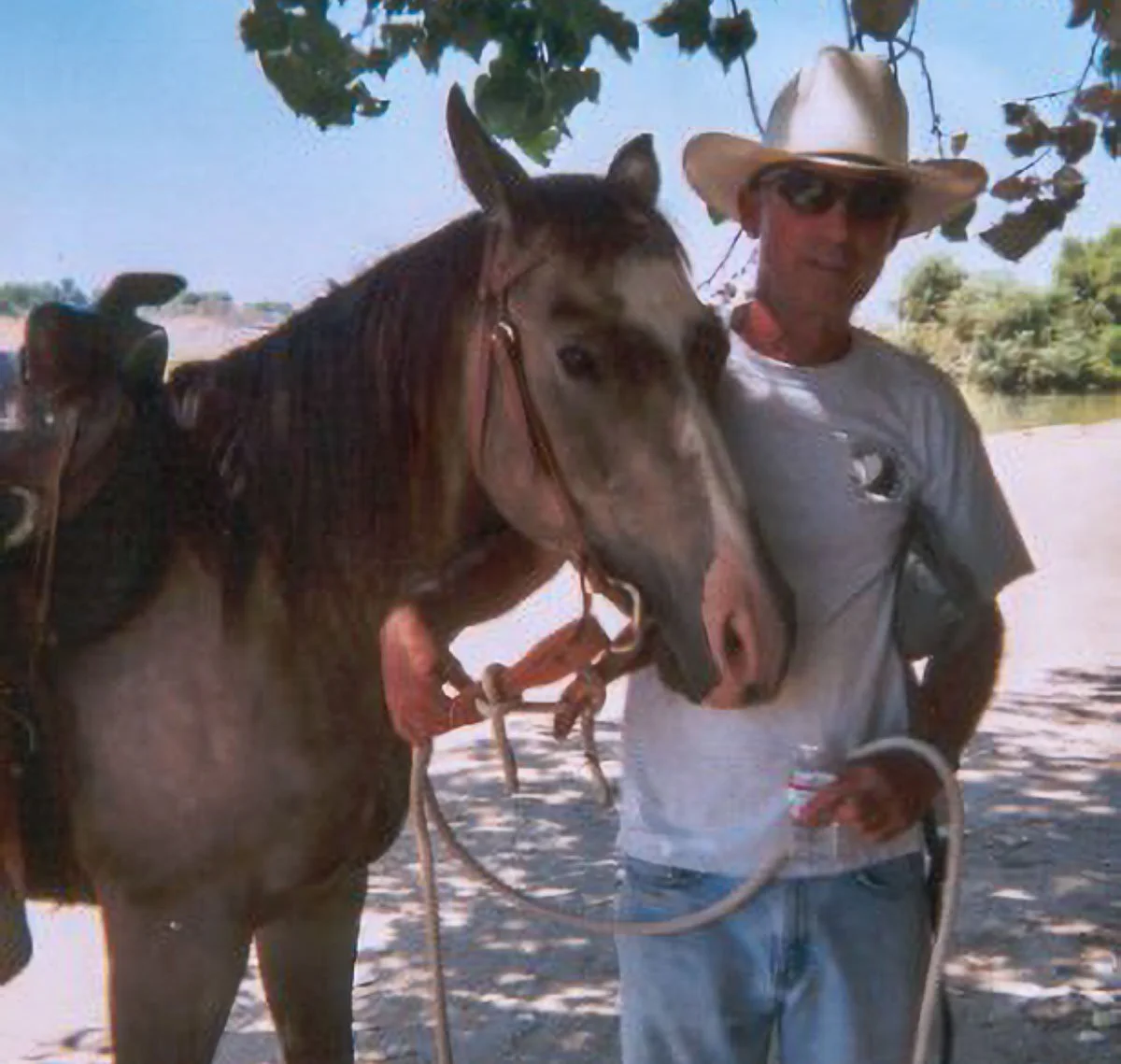
Charlie belonged to our neighbor, Susan. Five years old. A few owners. Not much consistency. When Susan tried to mount him, he wouldn’t stand still. He’d walk off. Shift his feet. Not out of malice—out of confusion. His body kept moving because his mind didn’t know where to settle.
On a group ride, Susan got hurt trying to get on him. She heard a pop. Broken kneecap. Eight weeks in a cast.
While she healed, she asked if I wanted to work with Charlie.
I said yes before I had time to talk myself out of it.
The Corral as Classroom
Charlie needed exactly the things Dusty didn’t.
Basic control of his feet. Direction. Attention. Stillness. He wasn’t dangerous or defiant. He just hadn’t been taught how to organize himself.
We worked early in the mornings, before the heat and before work. The dogs followed us out. The cat wandered over. A mockingbird sat on the fence like it was taking notes.
It was quiet and chaotic at the same time.
Everything I’d been watching on TV suddenly mattered. Where I stood. When I stepped. How quickly I released pressure. Charlie reacted immediately to mistakes I didn’t know I was making.
Every small improvement felt enormous.
Not because Charlie was suddenly brilliant, but because I understood why something worked—or why it didn’t.
For the first time, I wasn’t reacting.
I was teaching.
A Small Win That Changed the Math
One lesson I picked up from Ken McNabb’s show demonstrated how to teach a horse to come to you at a mounting block. Useful if you ever got hurt on the trail. Perfect for Susan when she returned to riding. It looked simple enough.
I tried it with Dusty.
Twenty minutes later, he was responding to my raised hand. Fifteen minutes after that, he was lining himself up at the block.
It worked. I got on. He stood still.
Then I tried it with Charlie.
Charlie learned it faster than Dusty.
That’s when it hit me. Either Charlie was a genius, or I was doing something right. The lesson worked on more than one horse. This wasn’t luck.
That small success mattered more than it should have.
Choosing to Be Bad at Something
For years, the corral had been a chore zone. Hay in. Manure out. Fix the fence. Repeat.
Now it felt different.
It felt like a place where effort turned into understanding. Where mistakes weren’t failures, just information. Where being bad at something wasn’t embarrassing—it was necessary.
I wasn’t just riding anymore.
I was studying. Watching. Trying. Getting things wrong. Adjusting.
For the first time in a long while, I liked being the student.
Not because I was good at it.
But because it felt like I was finally learning how to ask the right questions.
Previous: A Thousand Pounds of Quiet Energy
Next: Becoming a Student Again