Confidence in Strange Places
The Ride That Changed Things
Late Summer 2005
Susan called on a Wednesday afternoon.
"I'm cleared to ride again. Doctor says the knee's healed enough. I'll start riding Charlie again this weekend."
"That's great," I said, and meant it.
"I really appreciate you working with him while I was laid up."
"Are you kidding? I should be thanking you. He taught me more than I taught him."
She laughed, not quite believing me, and we said goodbye.
I hung up the phone feeling like I'd just been told my lease was up.
Charlie wasn't my horse. Never had been. He lived on the lot directly behind our property, close enough that I could hear him sometimes in the early mornings. But eight weeks of working with him had made him feel like something close to mine. Those sessions were about to end, and I wasn't ready for that.
"One more ride," Ranae suggested that evening. "Before she gets him. Take him out on the trail, see what he's really learned."
She didn't have to ask twice.
Saturday Morning
The plan was simple: a long loop through the fields east of our house. Flat country. Not scenic, but honest. The kind of ride that shows you what a horse has learned because there's nowhere to hide.
Ranae would ride Dusty. I'd take Charlie. Two hours, maybe three if the horses felt good.
We saddled up in the early light, before the heat could settle in. Charlie stood better than he had eight weeks ago—feet planted, head down, patient while I worked the cinch tight. Small thing. Huge thing.
Dusty waited by the gate like a professor watching a student take a final exam.
"You ready?" Ranae asked.
"We'll find out."
We headed east past the canal, following dirt roads between alfalfa fields. The country out here wasn't pretty. It was working land—crops in straight rows, irrigation ditches, and the accumulated junk of rural life scattered in the margins.
An old washing machine rusting in the weeds.
Sections of chain-link fence someone had dumped and forgotten.
Plastic tarps wrapped around metal posts, snapping in the morning breeze.
To a human, it's ugly.
To a horse, it's terrifying.
The Test
Charlie saw the first tarp from fifty yards out.
His head came up. Ears locked forward. His whole body went taut beneath me, coiling like he might bolt or spin or both.
I felt my own tension rise to meet his—that automatic response when you sense your horse is about to do something stupid. My hands tightened on the reins. My legs gripped harder.
Then I remembered something from one of those training videos: Your tension tells the horse the scary thing really is dangerous.
I made myself breathe. Loosened the reins slightly. Kept my legs on him but didn't clamp down.
"Easy," I said. More to myself than to him.
Charlie's ears flicked back, listening. He took one step forward. Then another.
The tarp flapped.
He stopped.
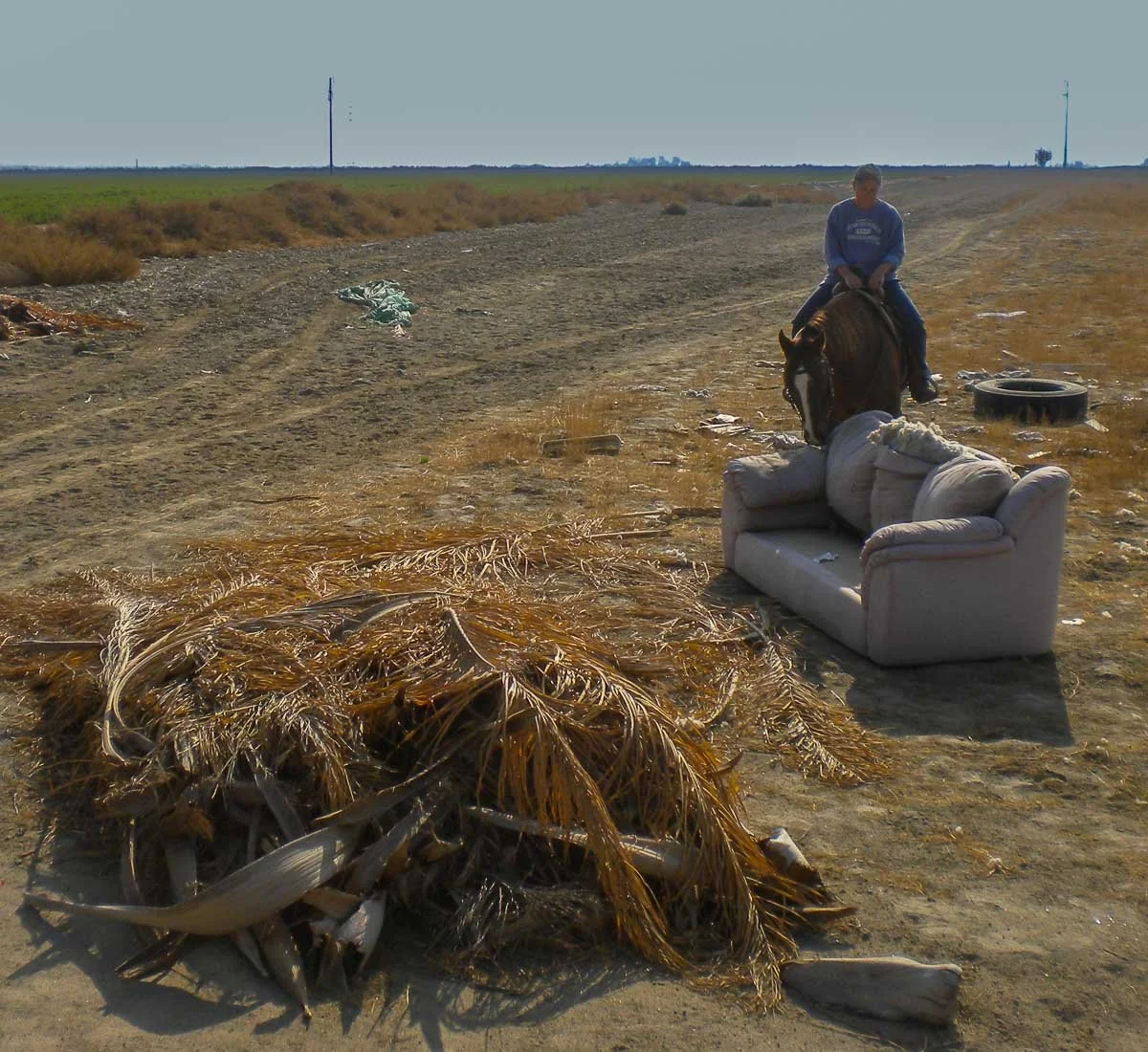
Dusty getting a good look at the kinds of “monsters” horses see in the real world.
I waited. Didn't pull. Didn't kick. Just sat there and let him work it out.
After what felt like an hour but was probably ten seconds, he took another step. Then two more. Then he walked past the tarp like it was nothing.
I exhaled so hard I might've deflated.
"Good boy," I said, and meant it more than I'd meant most things that month.
Ranae pulled up alongside me on Dusty. "That was nice."
"That was terrifying."
"But you didn't grab him. You let him think."
She was right. For maybe the first time on a horse, I'd gotten out of my own way.
We rode deeper into the fields. More tarps. Rusted equipment. A couch someone had left in a ditch, springs poking through the upholstery like metal bones.
Charlie looked at everything but didn't panic at anything.
I started to relax. Actually relax. Not the fake version where you tell yourself you're relaxed while every muscle is locked. Real relaxation, where your hips move with the horse's walk and your hands follow instead of fight.
For the first time in eight weeks, I wasn't managing Charlie.
I was riding him.
The Egg Farm
We smelled it before we saw it.
The egg operation sat at the end of a long dirt road—massive open-air barns housing thousands of chickens in stacked cages. The sound reached us before the smell did. A weird, rustling roar, like wind moving through dry leaves, except it was feathers and wings and ten thousand birds shifting in their cages all at once.
Dusty's head came up first. Then Charlie's.
Both horses stopped.
"You want to go around?" Ranae asked.
I looked at Charlie. His whole body was vibrating with alert tension, but his feet weren't moving. He was asking me a question: Do we go forward?
Eight weeks ago, I wouldn't have known how to answer. I would've hauled on the reins or kicked him into a panicked run or made some decision that told him I was just as scared as he was.
But I'd spent the last two months learning one thing above everything else: horses need a leader, not a passenger.
"No," I said. "We go through."
I squeezed my legs gently. Kept the reins soft. Exhaled.
Charlie took one step.
The noise got louder. The smell got worse.
He took another step.
Ranae moved Dusty up beside us, and both horses walked forward together—ears locked on the barns, nostrils flared, but moving.
As we passed the first building, I could see the chickens packed into their cages three feet off the ground, manure piled almost to the cage bottoms. The birds rustled and clucked and beat their wings against the wire. The horses' breathing got tight and fast.
But they kept walking.
Thirty yards. Fifty yards. A hundred.
Then we cleared the last barn, and the noise started to fade behind us.
Charlie's ears rotated back toward me. His breathing slowed. He shook his head once, hard, like he was throwing off the stress.
I reached down and patted his neck.
"Good boy. That's a good boy."
My voice came out rougher than I expected.
What I Didn't Say
We rode another hour in near silence. Ranae knew better than to make a big deal of what had just happened.
When we got back to the house and untacked the horses, she just said, "That was a good ride."
"Yeah. It was."
What I didn't say—what I couldn't quite articulate yet—was that I'd made decisions out there. Real ones. Not perfect, not polished, but clear enough that a nervous horse could understand them and choose to trust them.
It felt like learning a word in a language I didn't yet speak.
The Quiet After
That Saturday, I saw Susan walk back to Charlie's lot behind our property. I watched from the kitchen window as she groomed him, saddled him, and rode him around for the first time since her injury.
She looked good in the saddle. Confident. The knee was holding up.
Charlie stood perfectly still while she mounted.
I felt a stupid amount of pride about that.
Later that afternoon, I walked out to the corral where Dusty stood and just stared at the empty space where Charlie's lot connected to our property line. I could still see him over there, but it wasn't the same. Those early morning sessions were over.
Ranae came out and stood beside me.
"You okay?"
"Yeah. Just... I'm going to miss working with him."
She nodded. Waited a beat. Then said what we both knew was coming.
"You need your own horse."
I'd been thinking about it for weeks. Circling the idea without committing to it. Making spreadsheets about corral costs and trailer weights and feed bills. Clipping ads from the paper and telling myself I was just browsing.
But standing there in that empty corral, I stopped pretending.
"Yeah," I said. "I do."
Six weeks later, I'd find Tex.
And everything I thought I'd learned with Charlie would turn out to be just the beginning.