The Horse Who Won the American West
I had already bought one horse and killed him. This time I'd be more careful. I would see at least ten horses before I made a decision. Looking at different horses would give me an education — in horseflesh, and in the people who sold them.
It was 2007. Craigslist hadn't completely decimated the newspaper market yet, but the classifieds were thin. "Experienced rider," "3-year-old," and "green-broke" were the most common descriptions.
I wanted a Quarter Horse. Someone had once described them as "the horse who won the American West." That line would become my mantra anytime a fellow rider said something like, "I'm not sure the footing is good there," or "my horse may not want to cross that river." My answer was always the same. I wanted one somewhere between seven and ten years old — not so green I couldn't handle him, not so old the miles had caught up. I wanted papers. I wanted to know the lineage. And I hadn't decided on mare or gelding. Ranae had two geldings. That's what I knew. Mares can be fussy. But I grew up with the women's lib movement. Whether that applied to horses remained to be seen.
My neighbor had raised Paint horses and had a twelve-year-old named Elmo who'd carried their daughter through her horse-crazy teen years. He wasn't doing much. I went over, cleaned him up, and worked him in the round pen. He was good — responsive, moved nicely, nothing bad under saddle. But the whole time, the neighbors stood at the fence watching. Arms folded. Quiet. It was their horse, and they knew it, and they wanted me to know it too. I unsaddled and washed him. He had a lot of white on him. I'll never be accused of over-grooming a horse. One down.
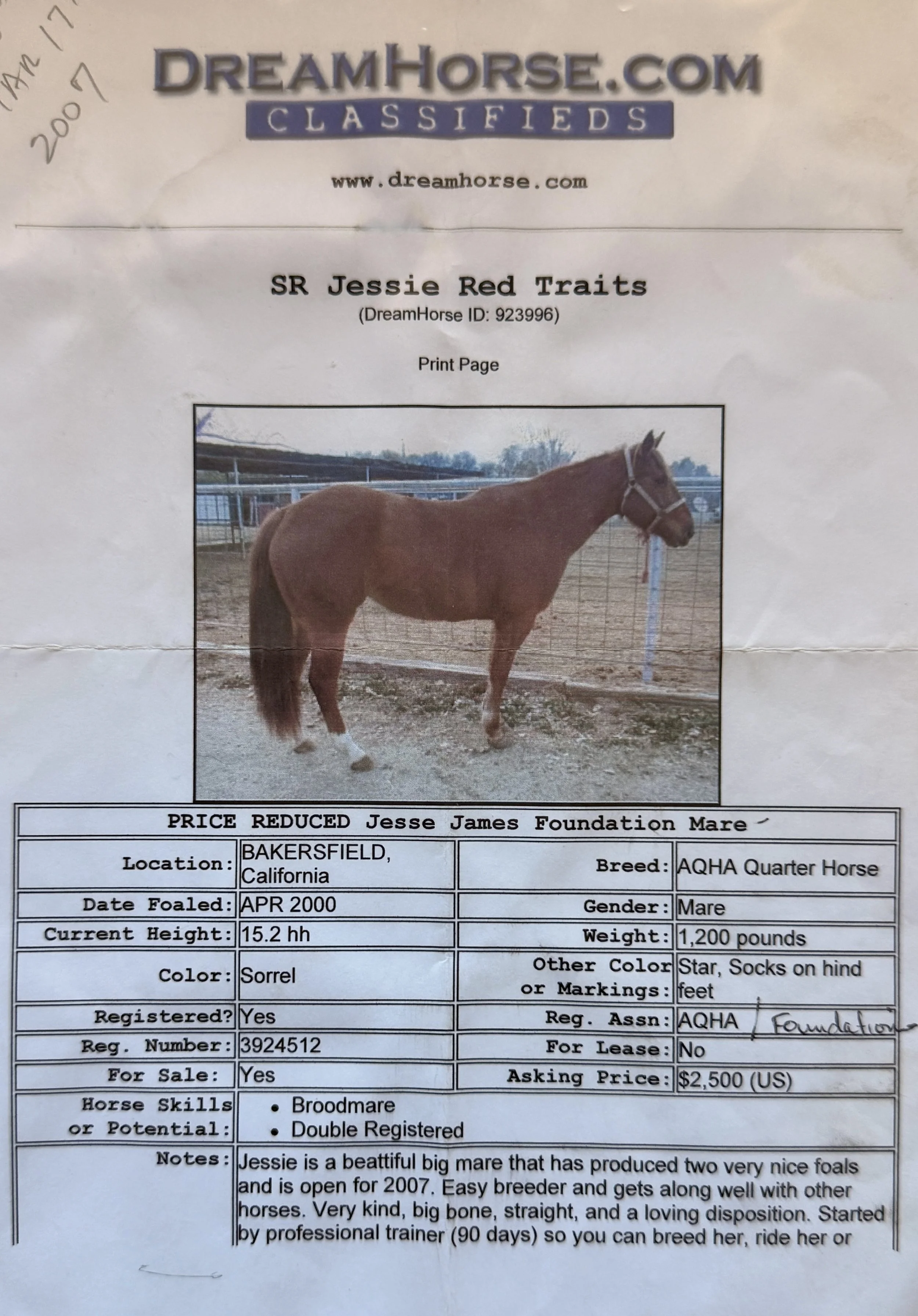
The DreamHorse.com listing that started it all, March 2007
I found a website called Dream Horse. Back then, shopping online for a horse was a little unusual. Mostly you got one photo, a description, and a price. A red horse came up — a Foundation Quarter Horse. I looked it up. The Quarter Horse registry was thought to be diluted with too many outside breeds. Foundation Quarter Horses traced back to the original bloodlines. A Quarter Horse with more Quarter Horse in it. That sounded like more winning.
She was 15.2 hands and seven years old, living right in Bakersfield. Listed as a broodmare. The notes read: Produced two very nice foals. Easy breeder and gets along well with other horses. Very kind. Started by a professional trainer (90 days), so you can breed her or ride her.
I called the number. A woman named Diane answered. We set up a time for the following afternoon.
Diane had a good number of horses. She'd bred Jessie once, hoping for a buckskin. Got a sorrel. Didn't want to try again. Jessie looked very good. She had a soft eye.
I didn't tell Diane how much experience I had, but I told her I was following a trainer named Clinton Anderson and asked if I could do some of his exercises on her horse. She said she'd never heard of him, but go ahead. The Natural Horsemanship movement was still finding its footing in 2007. Here was a woman who'd been selling horses her whole life and had never heard of Clinton Anderson. The horse world was larger than I could imagine.
I got my halter, lead rope, stick and string from the truck, put them on Jessie, and walked her into a small round pen. We worked through the exercises I knew. She moved easily. She turned when I asked, sped up and slowed down. I flexed her at the halter — she resisted at first, then gave. I thought that was encouraging. A horse who could learn. I did some desensitizing work, slapping the stick and string on the ground. Jessie was afraid of it initially, then settled. I wondered what Diane made of that.
I lost track of time in there. When I came out of the round pen I nodded to Diane. "She did really well."
"I've been selling horses a long time," Diane said. "I've never seen anyone work a horse like that."
I asked if I could come back in a few days with my saddle.
"Can't wait," was all she said.
That night I dreamt about that horse.
The next few days were excruciating. I wanted to mull it over, but I couldn't stop thinking about how — or whether — we'd connected in the round pen. I didn't want to go back too soon. That would weaken my negotiating position. But what if someone else bought her?
I called Diane and set up another time. I started with a little ground work, then saddled her and put in my Clinton Anderson snaffle bit. She fidgeted, but nothing bad. Once mounted, I flexed her side to side. She remembered. A leg squeeze and she walked off. I picked up a rein and she stopped. We changed directions, moved to a trot. The round pen was small, but when I asked for the lope she took off anyway. It was a little rough. I loved it. I sat relaxed, picked up a rein, said "whoa." She stopped.
Diane was watching from the rail, smiling. I steered Jessie toward her. "This is where I offer you a lower price and we haggle before settling on something," I said. "I'm at a disadvantage because I'm going to take her either way. But if you could knock a little off — she's not current on vaccines or dental — I'd appreciate it."
She agreed.
Driving home, I thought about the other eight horses I was supposed to ride first.
I didn't know any of that on the drive home. It was about a year later that I learned her registered name was SR Jessie Red Traits — a Jesse James Foundation Mare. Jessie James, foaled in 1943, was considered by cutting horse trainers of the 1950s and 60s to be one of the greatest horses to ever look through a bridle. Jim Reno, who owned him for several years, once compared him to Babe Ruth. I had bought a horse descended from Babe Ruth and didn't know it. That felt about right.