Run Off.
The first thing I learned about the horse business was that nobody in it seemed especially interested in explaining horses.
This was odd, because I had wanted to understand horses for as long as I could remember.
As a kid, I dragged home frogs, stray dogs, and anything else with eyes and a pulse that my mother failed to intercept at the front door. Animals made sense to me. Horses were different. They were larger, more powerful, and somehow locked behind a gate guarded by adults who already knew everything and had no interest in giving away the password.
My first real attempt came when I was eleven.
We had moved to Bakersfield from Southern California in 1965, and I had already been bounced through enough schools to feel like a transfer student in my own life. I had a paper route. Depending on the month, it paid eight to fifteen dollars, which, to an eleven-year-old boy, felt like serious money.
There was a stable about a thirty-minute bike ride from our house. The Bar-O. I rode over one day with money in my pocket and a lie already forming in my mouth.
“Do you know how to ride?” the man asked.
“Sure,” I said.
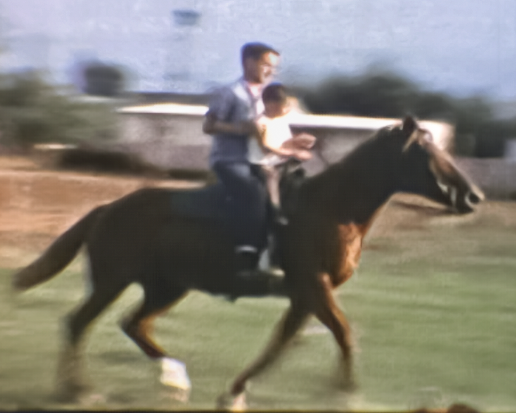
"We loped, and for a few seconds I felt the world open beneath me."
This was not true in any meaningful sense. I had ridden ponies at amusement parks, the kind that walk nose-to-tail in a circle while some weary adult makes sure nobody discovers independence. I had once ridden double on a horse owned by one of my father’s Marine buddies. We loped, and for a few seconds I felt the world open beneath me.
That was enough evidence for an eleven-year-old boy to declare himself qualified.
The stable owner gave me one rule.
“Don’t let that horse rush back to the barn. I’ll know by how sweaty he is.”
This was excellent advice. It was also useless to someone who did not yet understand the horse, the barn, sweat, or the difference between confidence and ignorance.
I rode out anyway.
For one hour I was in a western. I found a trail near the river. I trotted. I even cantered a little. The horse had more power in one shoulder than I had in my whole body. Then time got away from me, as time often does when a child is pretending to be someone who knows what he is doing.
I brought the horse back sweaty.
The man yelled.
I apologized. Then I asked if I could help cool the horse down. Give him a bath. Walk him. Do something. Anything. I was not trying to get away with something. I was trying to get in.
He scoffed and ran me off.
A month later, I came back. Same warning. Same ride. Same sweaty horse. Same apology. Same request to learn. Same result.
I did not go back.
By fifteen, I had advanced from ignorant to dangerously ignorant.
On a family beach vacation, I found another stable. Once again, a man asked if I could ride. Once again, I said yes, because teenage boys are nature’s way of proving that language can be used against reality.
He saddled a horse, and I headed for the beach, imagining a gallop through surf and sea spray.
The horse had other ideas.
There was a small bridge between us and the sand. The horse stopped at it as if the bridge had recently murdered a relative. I kicked. I prodded. I pleaded. I reasoned with him, which is what humans do when they have run out of knowledge.
Eventually, he crossed.
We made it about thirty yards onto the beach before the saddle began sliding sideways. This was another piece of information nobody had thought to include in my education: saddles must be secured by people who know what they are doing.
I did not.
As I slid toward horizontal, my feet touched the horse’s belly. He objected vigorously. I hauled myself partly upright just in time to go flying over his head.
Fortunately, we were on sand. Unfortunately, I still had the reins and just enough pride left to remount. I fumbled with the leather cinch, got it wrong in some new way, and rode back to the stable.
I told the owner what had happened and asked for another hour.
He called me a liar and ran me off.
This made me 0 for 2 with stable owners, though in fairness to them, I had lied to both.
Years later, on our honeymoon in Lake Tahoe, Ranae and I rented horses in the snow. Ranae actually knew something about horses. I had developed enough honesty by then to describe myself as a novice, a word that does a lot of work when “liability” sounds too harsh.
The stable owner had one rule.
“Don’t get off the trail.”
He said it once. Then again. Then again.
I assumed he thought we might get lost. This seemed unlikely. There was a foot of snow everywhere except the trail, where the horses had worn the path down to dirt. A man would have to work to lose that trail.
At one point, Ranae wanted a photo of me on horseback with Lake Tahoe behind me. She asked me to move a little. Then a little more. Then a little more.
The horse’s feet entered the snow.
I smiled for the camera.
Ranae’s face changed.
Then my horse folded himself neatly to the ground.
This, I realized, was why we were not supposed to get off the trail.
It took me years to understand the pattern. I did not want to use horses. I wanted to understand them. I had trained dogs. I had worked as a veterinary assistant. I had handled large animals in a clinical setting. But horses were different. Around horses, knowledge seemed to exist, but it was held by people who either could not explain it or did not care to.
Then Clinton Anderson showed up on RFD-TV.
Whatever people may think of him now, back then he did something none of those stable owners had bothered to do. He explained things. Horses were prey animals. Humans, dogs, and cats were predators. Pressure meant something. Release meant something. Timing meant everything.
Later, I watched him compete in the Road to the Horse DVD series. He took an unbroken three-year-old and, over three days, was riding it around the arena and finished standing on the horse's back cracking a stock whip. He was the first one I saw who bothered to lay them out in a sequence I could follow. For the first time, horsemanship did not look mystical. It looked learnable.
If one of those stable owners had taken ten minutes to show me how to cool out a horse, tighten a cinch, or read a worried eye, maybe I would have learned another way. Maybe I would have grown suspicious of television horsemen with polished production values and systems for sale.
But nobody had opened the door.
So when the door finally appeared on a television screen, I walked through it.