The Bathtub
November 2006
The Solution That Wasn't
We didn't have a proper water trough yet, so I used what I had.
An old cast-iron bathtub sat in the corner of the pen, half buried to keep it from tipping. It held water. It was heavy. It didn't move. It worked.
I told myself I'd replace it later. Once things settled. Once I had time.
Tex was supposed to be resting anyway. Short rides. Light work. Careful days. Nothing that should’ve put him at risk.
That’s what made the blood so jarring when I came home and walked out to the pen.
At first, I thought he’d scraped himself on something minor. Horses do that. Little cuts, little messes. But as I got closer, I saw the blood streaked down his leg, darker and heavier than it should’ve been.
He stood near the fence, weight shifted, watching me.
The cut was right where the edge of the tub met the ground. Sharp iron, hidden just enough to do real damage.
My stomach dropped.
Trying to Handle It
I tied him loosely to the paddock fence so I could get a better look.
I never got close to the wound. He wouldn’t let me.
Every time I tried to step in, his body changed. Ears back. Muscles tight. A warning I didn’t need explained. Whatever hurt him, he was protecting it.
I stopped where I was and watched him bleed, knowing that alone told me more than I wanted to know.
I’d worked as a vet tech for years. I knew wounds. I knew blood. I knew when something could wait and when it couldn’t.
This couldn’t wait.
I tried to talk to him, the way you do when you’re hoping calm will buy you time. He didn’t blow up. He didn’t panic. He just made it very clear he was done cooperating.
This was pain, not attitude.
Standing there, fence at my back, I understood something all at once: I didn’t have control of this situation, and forcing it would only make it worse.
I loaded him into the trailer.
The Vet
The vet took one look and sedated him. Heavily. More than either of us expected.
Even then, Tex was difficult to work with. His reactions were sharp and sudden, as if the sedation never quite reached whatever part of him was guarding that leg. The vet worked carefully, shifting position every time he moved.
It took longer than it should have.
Afterward, she stepped back and looked at me.
She told me Tex was reactive. Unpredictable.
Then she said it.
“Don’t try to change the bandage yourself.”
Not gently. Not as advice. As a boundary.
Bring him back in three days.
I nodded. There wasn’t anything else to do.
The Decision
The drive home was quiet.
Tex stood in the trailer, sedated and swaying, the bandage bright against his leg. I kept replaying the moment in the pen—the edge of the tub, the blood, the way he wouldn’t let me near him.
The bathtub had seemed like a practical solution. Cheap. Temporary. Good enough.
It wasn’t.
That night, I stood at the fence and watched Tex eat hay, the wrap already starting to sag where he’d bumped it.
The vet’s words stayed with me. Not because they were cruel, but because they were reasonable. She’d seen how Tex had reacted. She knew better than to trust a backyard horseman with something this complicated.
She wasn’t wrong to doubt me. Three months earlier, I’d spent ninety minutes wrestling Tex over a simple vaccine.
But another vet trip just to change a dressing wasn’t realistic. This lesson was already expensive enough.
I had three days.
Three days to figure out what the vet didn’t think I could do.
Three days to prove—maybe not to her, but to myself—that I could handle this.
I went inside and found the John Lyons video I’d been ignoring for months.
That night, I set my alarm for 4 a.m.
The Method
The video was about preparing horses for farrier work, but the principle was the same: get the horse to yield his hindquarters and cock his leg with just the toe touching the ground.
Not by force. By timing.
Lyons made it look simple. Ask for the yield. Wait for the weight shift. Release the instant the toe touches down. Repeat until the horse understands that holding the position brings relief.
I watched it three times, rewinding the sections where his timing was clearest.
The Work
The first morning was cold and dark.
There were no corral lights. I borrowed a shop light from a neighbor and clamped it to the fence. It threw more shadow than illumination, but it was enough.
I worked Tex for forty-five minutes before the sun came up.
Yield the hindquarters. Wait for the weight shift. Watch for the toe to touch.
My timing was terrible.
I released too early, and he shifted his weight back. I waited too long, and he moved his feet entirely, resetting everything.
But after twenty minutes, something changed. He cocked his leg and held the toe down for maybe three seconds. I released immediately, stepped back, let him rest.
We tried again. Five seconds that time.
By the time I had to leave for work, I could get him to hold the position briefly. Not long enough to change a bandage, but long enough to know we were heading somewhere.
The second morning, I got up at 4 a.m. again.
This time the timing came faster. Tex remembered what we’d worked on. When I asked him to yield and hold, he gave me ten seconds. Then fifteen. Then twenty.
I still didn’t touch the wound. I just worked the leg—rubbing it, holding it, letting him feel my hands without pressure or pain.
He stood.
Not because I was forcing him. Because he was choosing to.
On the third morning, I was up at 4 again. At 6, Ranae came out to help.
The Bandage Change
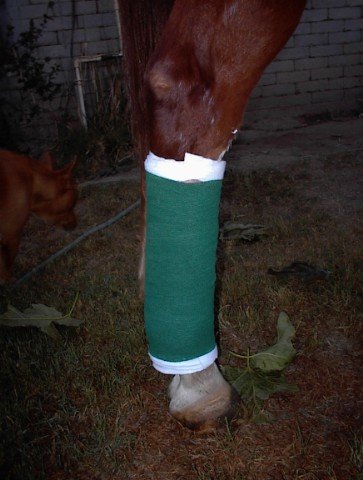
She held the lead rope while I knelt beside Tex’s injured leg.
I asked him to yield. He cocked the leg, toe barely touching the ground, and held it there.
My hands were steady. His breathing stayed even.
I peeled away the old bandage, cleaned the wound with the antiseptic paste the vet had given me, and wrapped it fresh. He shifted once, halfway through, but Ranae steadied him and he settled again.
When I stood up and stepped back, the new bandage was clean and tight.
Tex put his foot down, shook once, and went back to eating hay.
I looked at Ranae. She smiled.
“That was a pretty good feeling,” she said.
She was right.
What It Meant
I called the vet’s office that afternoon and told them the bandage had been changed, the wound looked clean, everything was holding.
The receptionist sounded surprised. Maybe the vet was too. I didn’t ask.
What stayed with me instead was the memory of those vaccines back in February. Tex moving his feet. Me chasing him in circles. Both of us frustrated and getting nowhere.
That version of me couldn’t have done this.
Three months earlier, I didn’t understand the difference between doing something to a horse and doing something with one. I thought effort was the variable that mattered. Work harder. Try longer. Push through.
But standing in that corral at 4 a.m., watching Tex hold his leg up because he trusted me enough to try, I finally understood what all those videos had been circling around.
Feel and timing weren’t abstract concepts.
They were the difference between force and cooperation.
Between a horse tolerating you and a horse trusting you.
Tex hadn’t just been teaching me how to handle an injury.
He’d been teaching me how to listen.
And for the first time, I finally did.